

Best Calculators for Every Decision
Make smarter business decisions with our high-precision tools. From ROI to CTR margins, get industry-leading accuracy instantly.
How to Use This Age Calculator
- Select your complete date of birth using the date picker (month, day, and year)
- Click “Calculate My Age” to generate instant results
- View your age in multiple formats including years, months, days, hours, and minutes
- Results update in real-time and account for leap years automatically
Understanding the Clickzy Age Precision Stack
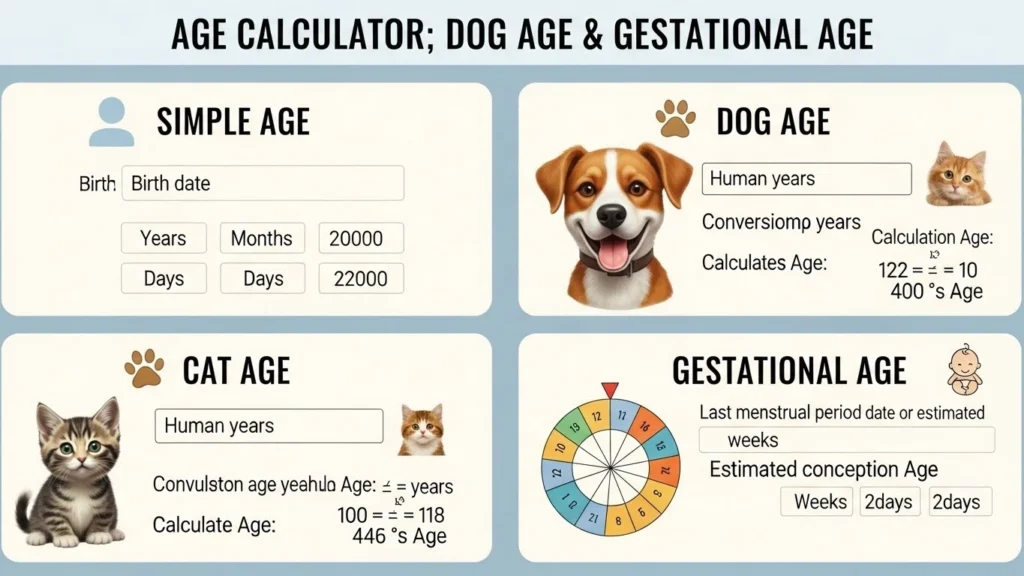
Most age calculators provide basic year calculations, but accurate chronological age measurement requires a systematic approach to handle calendar complexities.
The Clickzy Age Precision Stack™ is our proprietary framework that ensures every calculation accounts for variables that affect your true age.
The Six Precision Factors
Calendar System Alignment: We use the Gregorian calendar exclusively, which has been the international civil calendar standard since 1582.
This matters because historical dates before adoption or calculations involving other calendar systems can introduce errors of 10-13 days.
Leap Year Logic: Every four years adds an extra day to February, but century years follow different rules. Years divisible by 100 are not leap years unless also divisible by 400.
This means 2000 was a leap year, but 1900 was not.
Our calculator implements this three-tier rule set to ensure precision for anyone born on February 29 or in leap years.
Variable Month Lengths:
Months contain 28, 29, 30, or 31 days depending on the month and year. When calculating age in months and days, treating all months as 30 days creates cumulative errors.
Our system uses actual month lengths, so if you were born on January 31 and it’s currently March 1, the calculation properly handles February’s shorter length.
Time Zone Consideration:
Your chronological age technically changes at midnight in your local time zone.
Someone born on March 15, 2000 at 11:00 PM EST turns 25 at a different absolute moment than someone born the same date at 11:00 PM PST.
Our calculator uses your browser’s local time zone to provide the most accurate result for your location.
Edge Case Protection:
The system validates against impossible dates, future dates, and formatting errors.
It also handles the February 29 birth date scenario by calculating age correctly on non-leap years when February 29 doesn’t exist.
Precision Granularity:
Beyond years and months, the calculator extends to weeks, days, hours, and minutes.
This level of detail matters for legal age verification, developmental milestone tracking in infants, and precise record-keeping.
What Most Age Calculators Don’t Explain
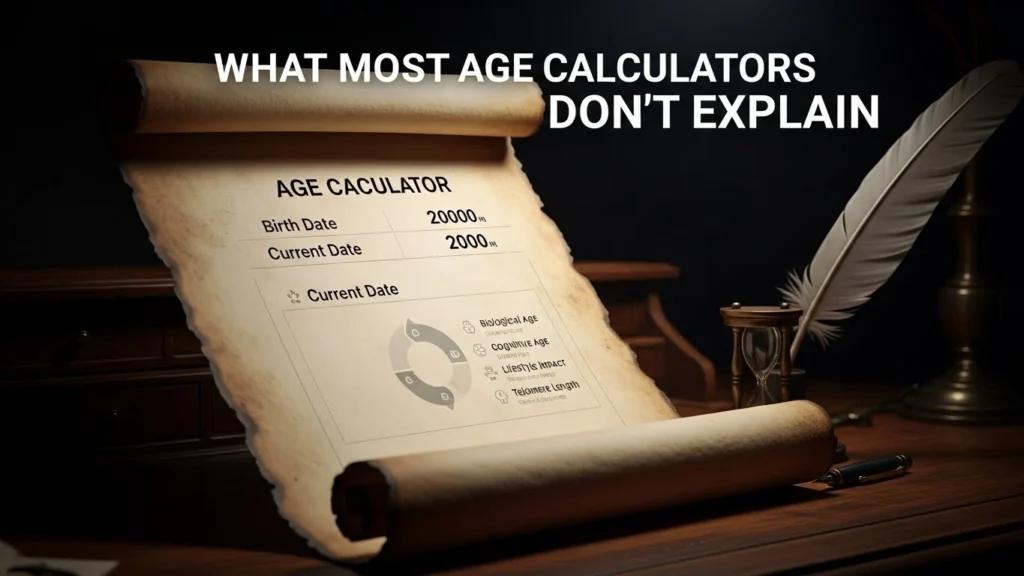
The Century Boundary Problem:
People born in 1999-2000 often get incorrect calculations from basic tools that don’t properly handle the century transition.
The year 2000 was a leap year, but simple calculators using modulo-4 logic without the century rule would calculate it incorrectly.
Birthday Cutoff Time:
Your age changes at midnight, but midnight in which time zone?
If you’re travelling across time zones on your birthday, you could technically “turn” a year older twice or have a birthday that lasts 25+ hours.
Most calculators use UTC (Coordinated Universal Time) or the server’s time zone, which may differ from yours by up to 12 hours, potentially showing you as a day younger or older than you actually are in your location.
The “Month” Measurement Inconsistency:
When a calculator says you’re “24 years and 3 months old,” it’s making an assumption about what “3 months” means. Is it 90 days?
Or is it three calendar months (which could be 89-92 days)? There’s no universal standard.
Our calculator uses calendar months, meaning if you were born on the 15th, you turn one month older on the 15th of each subsequent month.
Historical Date Limitations:
For birth dates before October 15, 1582 (when the Gregorian calendar was adopted), age calculations become ambiguous.

Different countries adopted the calendar at different times—Britain and its colonies didn’t switch until 1752.
A person born on October 3, 1582 under the Julian calendar would have “skipped” to October 13, 1582 the next day when their region adopted the Gregorian system.
Legal vs. Chronological Age:
In some jurisdictions, legal age of majority doesn’t align with chronological age.
Some countries consider you to turn a year older on January 1 regardless of birth date (like the traditional Korean age system, though South Korea officially abandoned this in 2023).
Our calculator shows chronological age only, which may differ from legal age in your location.
Common Use Cases for Age Calculation
| Scenario | Why Precision Matters |
|---|---|
| Legal Documents | Contracts, wills, and age verification for services require exact chronological age |
| Medical Records | Pediatric development uses age in months and weeks; elderly care uses precise years |
| Retirement Planning | Social Security benefits begin at exact ages (62, 66, 67, 70) down to the month |
| Insurance Policies | Premium rates change at age milestones; one-day difference can affect annual costs |
| School Enrollment | Most districts use September or January age cutoffs for grade placement |
| Milestone Tracking | Parents track infant development in weeks; couples track relationship duration |
Types of Age Calculations
Beyond standard chronological age, different contexts require specialized calculations:
Chronological Age: Your age from birth date to current date using the Gregorian calendar.
This is what our main calculator provides and what most people mean by “age.”
Corrected Age (Adjusted Age): For babies born prematurely, developmental milestones use corrected age calculated from the due date rather than birth date.
A baby born 8 weeks early at chronological age 6 months has a corrected age of 4 months for milestone assessment.
Gestational Age: Used during pregnancy, measured in weeks from the first day of the last menstrual period (LMP) or from conception date plus two weeks.
Full-term pregnancy is 37-42 weeks gestational age.
Bone Age: Determined by X-ray of hand and wrist bones, used in pediatrics to assess physical development. May differ from chronological age in growth disorders.
Biological Age: An estimate of your body’s physiological age based on biomarkers like blood pressure, cholesterol, inflammation markers, and fitness levels.
Can be younger or older than chronological age.
Mental Age: A historical concept from intelligence testing, now largely abandoned, that compared cognitive abilities to age-based norms.
Common Mistakes When Calculating Age
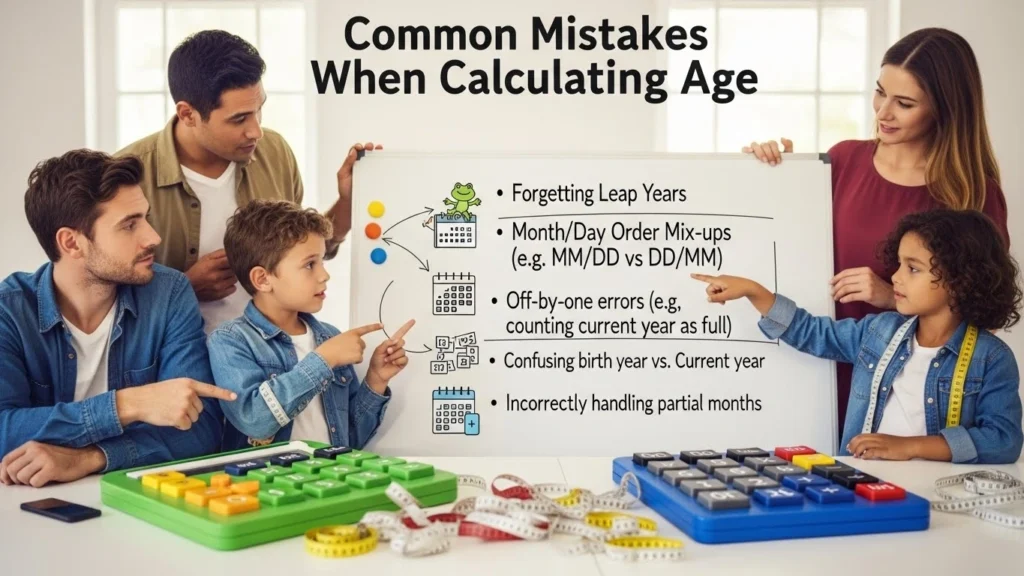
Before you trust a calculation result, watch for these frequent errors:
Ignoring Leap Years: Simple calculators that divide days by 365 will accumulate errors. Over an 80-year lifespan with 20 leap years, this method would be off by nearly three weeks.
Assuming 30-Day Months: Multiplying years by 12 and adding months works until you need precision.
Someone born January 31 who turns a month older on February 28 (or 29) has a different month length than someone born February 1.
Date Format Confusion: Is 03/04/1990 March 4th or April 3rd?
The United States uses MM/DD/YYYY while most other countries use DD/MM/YYYY. Always verify the format matches your intention.
Entering Future Dates: Some calculators will process future birth dates and show negative ages or incorrect results.
Always validate that the birth date is in the past.
Time Zone Errors: Using a calculator set to a different time zone can make you appear a day younger or older depending on the time of day you calculate.
Age Calculator vs. Birthday Calculator
These terms are often used interchangeably, but they serve slightly different purposes:
An age calculator tells you how old you are right now or were at a specific date.
You input your birth date and optionally a target date, and it returns your age at that point in time.
A birthday calculator typically works in reverse or provides birthday-related information.
You might input an age and get the corresponding birth year, or calculate what day of the week your birthday falls on in future years, or determine how many days until your next birthday.
Our tool functions primarily as an age calculator but also displays days remaining until your next birthday, giving you both age determination and birthday countdown functionality.
Related Age Calculations You Might Need
Explore our complete suite of age-related calculators:
Get Your Exact Age in Seconds
Whether you need your precise age for legal documentation, medical records, retirement planning, or simple curiosity, this calculator provides accurate results accounting for leap years, variable month lengths, and time zone considerations.
The Clickzy Age Precision Stack™ ensures you get reliable chronological age measurements you can trust.
Enter your birth date above to calculate your age instantly, or explore our related calculators to determine age differences, retirement eligibility, or age in different measurement systems.
Need a different type of calculation?